
Asset Tracking in Large Facilities: Barcode, RFID or Both? What Published Cases Show
Barcode, RFID or Both for Asset Tracking?
In a large facility, such as a hospital campus, a plant, a university or a distribution centre, the practical question is rarely which technology is better in general. It is which one suits each class of asset, and what it costs to keep the asset records true. The two options also overlap more than the debate suggests: a barcode label and an RFID tag can carry the same asset identifier, so the choice is about how that identifier is read, not what it says (Source: GS1 UK, retrieved 2026). For a wider comparison of the technologies, see our guide to barcode, QR code, RFID and NFC.
This article looks at six published sources that report results from tracking assets or counting stock with barcodes, passive UHF (ultra-high frequency) RFID or active RFID. It compares what each source measured, who published it and what it did not test. The scope is barcodes, including 2D codes such as GS1 DataMatrix, and passive UHF RFID. Active tags and real-time location systems (RTLS) appear only where the cases use them.
We found no independent study that compares barcodes and RFID head to head for asset tracking in a large facility. The closest head-to-head counted retail jeans, not equipment. Most asset-tracking results come from hospitals and are published by suppliers or trade media, and most compare a tracking system with manual searching rather than with barcodes. The text flags the source type each time.
| USD 21–28 B | Global asset tracking market in 2025 across three research firms: IMARC Group USD 21.3 billion, Fortune Business Insights USD 25.98 billion and P&S Intelligence USD 27.8 billion. Grand View Research put 2024 at USD 24.14 billion. Growth forecasts range from 10.1% to 16.5% a year because each firm defines the market differently. (Sources: as named, 2024–2025) |
| 18 min → 3 min | Median time for respiratory therapists to locate a ventilator at Cleveland Clinic before and after a Wi-Fi-based active RFID system tagged 300 ventilators (218 plus 82 noninvasive). A before-and-after comparison, not a barcode comparison. (Source: Respiratory Care, 2013) |
| 140,000 hours | Clinical time that six NHS England trusts reported releasing to patient care after adopting GS1 barcodes at the point of care. The programme covered patients, products and places, so it is not an asset-location result. (Source: GS1 UK, A Scan of the Benefits, 2020) |
| 2 h vs 53 h | Time to count 10,000 retail items with passive UHF RFID versus a barcode reader in a University of Arkansas study of two Bloomingdale's stores. Retail denim, not assets, and the nearest independent head-to-head we found. (Source: University of Arkansas RFID Research Center, 2009) |
| 39 of 39 | Passive UHF tags on tools read in every one of 30 runs inside a storage container, with mean read times of 4.87 to 7.97 seconds by method. A small laboratory proof of concept with no barcode comparison. (Source: Wetzel et al., Auburn University, 2022) |
What Published Cases Actually Compare
Six sources cover the ground between them. The table shows what each one tested, so that a result is not read as a barcode-versus-RFID verdict when it is not.
| Case | Technology | Reported result | Source type | Compared with barcodes? |
|---|---|---|---|---|
| Cleveland Clinic ventilators (2013) | Wi-Fi-based active RFID | Median locate time fell from 18 to 3 minutes for 300 ventilators | Peer-reviewed journal | No |
| East Kent Hospitals (2019) | Active RFID; passive UHF being added | Tag data showed 98 surplus infusion pumps, worth about £150,000 | Supplier case study | No |
| Shands at UF (2012) | Battery-powered Wi-Fi RFID tags | 98% less search time for missing items after about six months | Trade press, early in-house study | No |
| Scan4Safety, NHS England (2016–2019) | GS1 barcodes | 140,000 clinical hours released; nearly £5 million recurring inventory savings | Standards body report, trust-submitted data | Barcodes only; covers more than assets |
| Auburn tool tracking (2022) | Passive UHF RFID | All 39 tags read in every run; 4.87 to 7.97 seconds mean | Academic conference paper | No; laboratory setting |
| University of Arkansas, Bloomingdale's (2009) | Passive UHF RFID and barcode | 10,000 items counted in 2 hours versus 53 hours | University study, news release | Yes; but retail denim |
The three hospital cases share a feature that is easy to miss: they used battery-powered active tags. Active tags transmit an identifier at regular intervals to networked readers, which gives a location without anyone walking up to the asset (Source: East Kent case study, 2019). That is a location job. In the Cleveland Clinic study, a Wi-Fi-based system cut the median time to locate a ventilator from 18 minutes to 3 minutes, while the change in staff satisfaction was not statistically significant (Source: Respiratory Care, 2013). Shands reported a 98% cut in search time for missing items after about six months, from an early in-house study relayed by trade press (Source: RFID Journal, 2012).
East Kent Hospitals reported that tag data revealed an excess of 98 infusion pumps, worth about £150,000, which were taken out of circulation. The document is a supplier case study. Its statement that a full audit with passive tags will take days instead of weeks or months describes what the trust expects, not a measured result (Source: Paragon ID case study, 2019).
Scan4Safety is the large barcode example. Six NHS England trusts placed GS1 barcodes on patient wristbands, equipment and locations, and reported 140,000 hours of clinical time released, nearly £5 million in recurring inventory savings and £9 million in one-off inventory reductions (Source: GS1 UK, 2020). The figures come from data submitted to the Department of Health and Social Care, and GS1 UK, which publishes the standards behind the barcodes, compiled the report. The programme also covered patients and consumables, so it is not an asset-location result. A 2026 qualitative study of one demonstrator site found that the benefit for tracing devices depends on how many items are tracked and on staff scanning consistently at the point of care, and it identified trade-offs and new safety risks (Source: BMJ Health & Care Informatics, 2026).
The Auburn University study is the cleanest passive UHF test, and it is a small one. Researchers tagged 39 tools in a storage container and read them with a handheld reader, a robot driven by a person and an autonomous robot, ten runs each. Every tag was read in every run, and mean times were 5.59 seconds for the handheld, 4.87 seconds for the manually driven robot and 7.97 seconds for the autonomous robot. The authors note the laboratory setting, the lack of obstructions and the short distances, and they chose a general-purpose inlay because the tools mixed metal, rubber and plastic (Source: Wetzel et al., ASC 2022 proceedings, 2022). It did not test barcodes.
The University of Arkansas study is the nearest true head-to-head. In two Bloomingdale's stores, staff counted items with both barcode and passive UHF RFID readers. Counting 10,000 items took two hours with RFID and 53 hours with a barcode reader, a cycle-count time about 96% shorter. The study's 27% accuracy gain came from a simulation that fed RFID counts into a copy of the store's inventory system, not from the live system (Source: University of Arkansas, 2009). It covered denim in retail and was published in 2009. In our view, the direction of the timing result probably carries over to counting many assets in one space, but the size of the gap will not, because retail stock is many identical items and assets are usually single, varied items. For retail context, see our article on RFID adoption in retail.
Taken together, the cases support three narrow statements. Location systems cut search time in hospitals, according to one peer-reviewed study and two supplier or trade sources. A barcode programme can deliver efficiency and traceability where scanning is consistent. Passive UHF can read many tags quickly in a test. None of them shows which carrier is cheaper or more accurate for your assets over several years.
How the Two Technologies Differ in a Large Facility
A barcode, such as a GS1-128 linear code or a GS1 DataMatrix 2D code, is read by an optical device. A passive RFID tag is read by a reader using radio waves (Source: GS1 UK, retrieved 2026). The passive UHF standard in common use is GS1 EPC Gen2, whose current release is 3.0.1 (February 2026). GS1 aligned it with ISO/IEC 18000-63, which covers 860 to 960 MHz (Source: GS1 Gen2 standard, Release 3.0.1, 2026; Fierce Electronics, 2005).
| Factor | Barcode (1D or 2D) | Passive UHF RFID | What to check in your facility |
|---|---|---|---|
| How it is read | Optical scan; the operator aims at each label | Radio read; tags in range answer the reader, so a clear optical view of each tag is not needed | Whether assets sit in cabinets, behind doors or on high shelves |
| Reading many at once | One label per scan | Many tags per pass; Auburn read 39 tags in about 5 to 8 seconds in a laboratory | Audit size and how often audits run |
| Metal and liquids | Not affected by radio physics; the label must stay visible and legible | A standard tag is detuned on metal; on-metal tags hold the antenna off the surface | Read range on your actual assets, tag by tag |
| Cost | Label cost depends on material and volume; no independent price survey found | Auburn authors describe passive tags as costing cents; ask for quotes for the tag type your assets need | Full cost per asset, not tag price alone |
| Standards and identifiers | GS1-128 and GS1 DataMatrix; print quality graded under ISO/IEC 15416 (linear) and 15415 (2D) | GS1 EPC Gen2, aligned with ISO/IEC 18000-63 (860 to 960 MHz) | Both can carry the same GIAI |
| Labour | Someone must reach and scan each asset | A reader can be walked, pushed or driven through a space | Who audits, how often, and with what equipment |
| Location answer | Where the asset was last scanned | Where it was last read; live location needs active tags or RTLS | Whether you need "last seen" or "where is it now" |
Where barcodes hold up
Barcodes work with any compatible scanner, and GS1 describes its barcodes as system and device agnostic, which matters when assets belong to several departments or contractors (Source: GS1 UK, 2020). A barcode is also easy to check. A verifier that conforms to ISO/IEC 15426 measures print quality and returns an overall grade, and GS1 builds its verification templates on ISO/IEC 15416 for linear symbols and ISO/IEC 15415 for 2D symbols (Source: GS1 support, 2024; GS1 General Specifications, 2024). That lets you test whether a label will still grade acceptably after the cleaning and handling it will face. The weak point is the person. Every asset has to be found, reached and aimed at, and the Scan4Safety evidence suggests results depend on staff doing that consistently.
Where passive UHF RFID helps
Passive tags need no battery. The Auburn authors describe their cost as cents, against USD 30 or more for a Bluetooth tool tag (Source: Wetzel et al., 2022). A reader can pick up many tags in one pass, which is why the audit examples in this article, the Auburn robot and the East Kent antenna trolley, centre on moving a reader through a space. East Kent's supplier says the trolley's read range is typically up to eleven metres (Source: Paragon ID case study, 2019). That is a supplier figure, so measure your own.
Where each one strains
Metal is the best-known problem for RFID. An ordinary passive tag placed on a metal object is detuned, much as touching a radio antenna with metal affects the radio, and the usual answer is an on-metal tag that lifts the antenna off the surface (Source: RFID Journal, retrieved 2026). RFID Journal's editor says tagging metal with passive RFID is not difficult. That is an expert opinion, not a test result, and the Auburn authors still found it hard to pick one tag position for tools of mixed materials. Range creates a second issue. A reader that reaches several metres can also pick up tags in the next room, so read zones need to be defined and checked. Barcodes strain in other places: labels can be hidden, damaged or worn, and every audit depends on labour.
Where active tags and RTLS fit
Active tags carry a battery and transmit an identifier at intervals, so fixed readers can show where an asset was last heard without anyone scanning it. That is how Cleveland Clinic, East Kent and Shands tracked equipment. RTLS is the broader term for systems that report where tagged items are. They answer "where is it now", which neither barcodes nor passive tags do on their own, and they bring battery and reader-infrastructure costs that passive tags avoid.
Using Both: One Identifier, Two Carriers
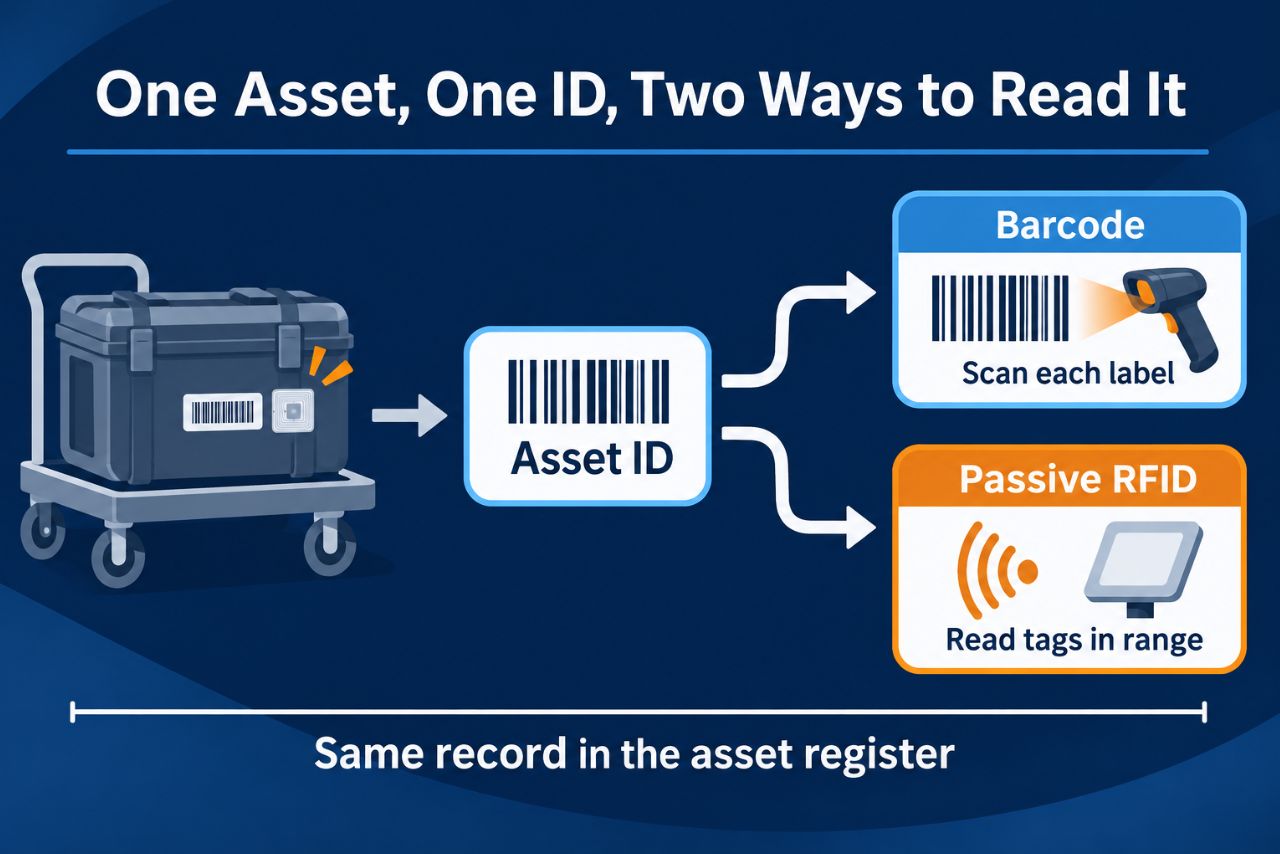
The GS1 Global Individual Asset Identifier (GIAI) is a globally unique identifier for an individual asset within an organisation or across a supply chain. It can be encoded in a GS1-128 or GS1 DataMatrix barcode or in an EPC/RFID tag, so a record can be read either way. The related Global Returnable Asset Identifier (GRAI) covers returnable assets (Source: GS1 UK, retrieved 2026). GS1 UK's guidance for construction advises giving each managed asset one primary identifier that stays with it for its life, and linking its records to that identifier (Source: GS1 UK, retrieved 2026).
That has a practical consequence. If the asset register is keyed to one identifier, the carrier becomes a per-asset decision that can change later without rebuilding the records. East Kent took this route: after its active tags, the trust began labelling devices with GS1-compliant asset labels that include passive RFID (Source: Paragon ID case study, 2019).
One possible pattern is a barcode on every asset, passive tags added where audits are frequent or assets are hard to reach, and active tags used only where live location is worth the cost. We offer it as a hypothesis to test in a pilot, not as a result from the cases above.
How to Run a Fair Pilot in Your Facility
Because no independent head-to-head exists for your kind of facility, a pilot is the most reliable evidence you can get. Keep it fair by changing one thing at a time:
- Define the job first. Audit speed, search time and live location are different problems, and each needs its own measure.
- Choose asset classes that cover your worst cases, such as bare metal, painted or cleaned surfaces, items inside cabinets, plastic housings and outdoor equipment.
- Tag the same assets both ways, with a barcode label and an RFID tag that carry one identifier, so any difference comes from the carrier and not from the sample.
- Audit one zone by barcode, record the time, and count the mismatches between the register and what you find.
- Audit the same zone by RFID, then check every mismatch by hand to see which method was right.
- Log misses by material and position, so a failure on one asset type is visible and not averaged away.
- Repeat after weeks or months, to see label wear, tag damage and drift in the register.
- Cost the whole job, including labels, tags, readers, labour and the link to the asset register, not the tag price alone.
Questions to Ask Before You Buy
- Which job does this solve: audit speed, search time or live location, and does the supplier's evidence address that job?
- Which materials has the tag or label been tested on (bare metal, liquid-filled items, plastic), and at what read range?
- Can one GIAI be encoded on both the barcode and the RFID tag, and does our asset register accept it?
- How are read zones controlled so that a reader does not report assets from the next room?
- How long will labels and tags last through cleaning, handling and weather, and can print quality be re-graded after wear?
- Is the evidence an independent study or a supplier case, and what exactly was compared before and after?
- What is the full cost per asset, including tags, labels, installation, readers, software, labour and replacements?
- Who will scan or walk the reader, how often, and how are exceptions handled?
- What happens when a tag or label fails, and how will a missing asset show up in the next audit?
Match the Technology to the Job, Then Test It
The published evidence supports narrower claims than most marketing does. Location systems shorten searches in hospitals. Barcode programmes deliver where staff scan consistently. Passive UHF reads many tags quickly under test. None of that decides barcode versus RFID for your assets.
A safer approach is to key the asset register to one identifier, choose the carrier for each class of asset, and measure the result in your own facility. With one identifier behind both carriers, a wrong first choice is a labelling change, not a records rebuild.
Frequently Asked Questions
Is RFID more accurate than barcodes for asset tracking?
We found no independent head-to-head study for assets in large facilities. The closest, a 2009 retail study, counted 10,000 items in two hours with RFID versus 53 hours with a barcode reader, and its accuracy gain came from a simulation. Run a pilot on your own assets.
Can the same asset ID be used on a barcode and an RFID tag?
Yes. The GS1 Global Individual Asset Identifier (GIAI) can be encoded in GS1-128 or GS1 DataMatrix barcodes or in an EPC/RFID tag, so one record can be read either way. Confirm that your asset register software accepts the identifier before you label anything.
Does metal stop RFID tags from working?
A standard passive tag placed on metal is detuned and can read poorly. On-metal tags lift the antenna off the surface so that it can work. Material and tag position still affect range, so test tags on your actual assets before you commit to a tag type.
What is the difference between passive RFID, active RFID and RTLS?
Passive tags have no battery and answer a reader, so location means where they were last read. Active tags have a battery and transmit at intervals to fixed readers, as in the hospital cases here. RTLS is the broader term for systems that report where tagged items are.
Scanning in a demanding environment?
Share your operating conditions, and we'll give you an honest view of what fits.
Explore ALVICS Products → Warehousing Solutions →