
How AI Is Changing Barcode Scanning and AIDC Technology
AI in AIDC: Separating Signal from Noise
Artificial intelligence is one of the most over-applied terms in enterprise technology marketing, and automatic identification and data capture (AIDC) is no exception. "AI-powered" appears on scanner product pages more often than the underlying capability is explained. Even the size of the neighboring machine vision market depends on who is counting: 2025 estimates from four research firms run from about USD 6.8 billion to USD 26.4 billion, because each defines the market differently. When a term is that loosely scoped, specifics matter.
The honest picture is uneven. AI is already embedded in decoding and image-processing software and in device-fleet analytics. It is in early commercial use for vision-based identification in specific settings, such as fresh-produce checkout. It is at an early stage for natural-language interfaces on the warehouse floor. And it has not replaced barcode scanning in general industrial and warehouse identification.
This article maps those layers using vendor documentation, retailer and trade reports, patent filings, survey research and regulatory sources, as of October 2026. It also gives you the questions to put to any supplier who says "AI": which technique, applied to which problem, measured how, and on whose data. Where the only evidence is a supplier's own claim, the text says so.
| USD 6.8–26.4 B | Four research firms' 2025 estimates for the global machine vision market, growing roughly 7–9% a year. Global Market Insights: USD 6.8 billion (industrial machine vision only). Fortune Business Insights: USD 12.56 billion. MarketsandMarkets: USD 15.9 billion (machine vision systems). Fairfield Market Research: USD 26.4 billion. Scope differs by firm. (Sources: as named, 2025–2026) |
| 74% / 65% | Share of European warehouse decision-makers who said machine vision and fixed industrial scanning could save time and eliminate errors, and who planned to implement machine vision within one to five years. Nearly 60% of respondents said they did not know how to start automating. Vendor-commissioned survey of more than 1,700 warehouse associates and decision-makers. (Source: Zebra Technologies Warehouse Vision Study, 2025) |
| 8.4 s → 3.7 s | Average handling time per loose item at attended checkouts at a Czech grocery chain of about 330 stores after it adopted camera-based AI product recognition. Retailer-reported pilot result. (Source: Retail Optimiser, November 2025) |
| 25+ devices | Minimum fleet size in reseller listings for one major manufacturer's per-device analytics subscription. This is a commercial minimum, not a performance threshold. (Source: reseller listings for Zebra VisibilityIQ Foresight, retrieved October 2026) |
| 2 Dec 2027 | Date from which EU AI Act high-risk obligations apply to AI that allocates tasks or monitors worker performance, after the Digital Omnibus on AI moved it from 2 August 2026. (Sources: Regulation (EU) 2026/1744; Cuatrecasas, 2026) |
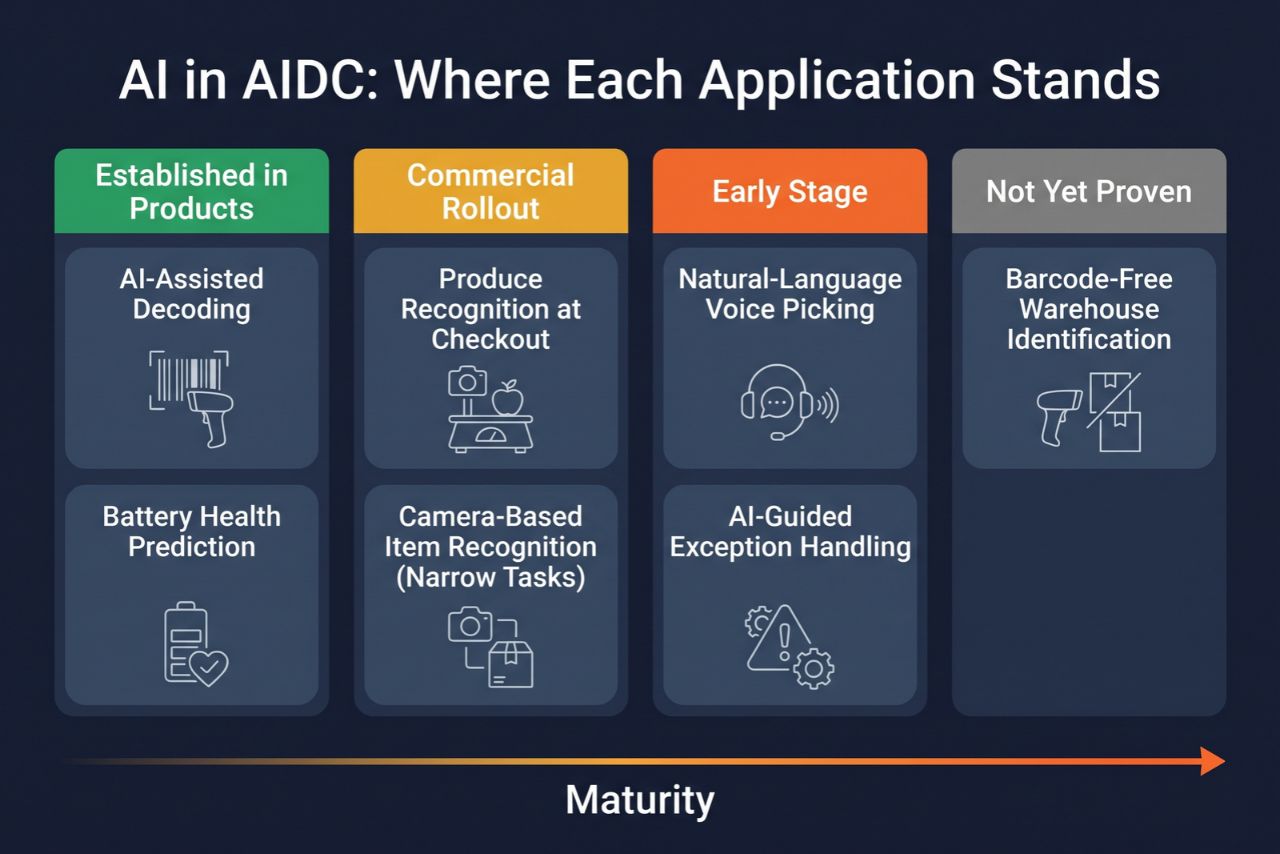
The spectrum below places each application by maturity, using the evidence in the rest of this article. It is an editorial assessment, not a market survey.
| AI application | What it does | Evidence we found | What to ask |
|---|---|---|---|
| AI-assisted decoding | Locates codes, enhances blurred or damaged images, and predicts decodability | Vendor documentation and patents; no independent first-read comparison | Which stage uses AI, and results on our worst labels |
| Fleet analytics | Predicts battery health and remaining useful life across a device fleet | Vendor documentation and reseller listings; subscriptions with minimum quantities | Minimum devices, term, ecosystem and cost of failures avoided |
| Vision AI at checkout | Recognizes loose produce so no printed code is needed | Retailer and supplier reports of pilots and rollouts; not independent audits | Results on our items, including similar-looking varieties |
| Voice and language interfaces | Natural-language voice recognition and AI guidance for exceptions | Supplier materials only; no independent measurements | Pilot in our noise, accents and exception types |
AI-Enhanced Decoding: Smarter Software Inside the Reader
The decoder is the software that turns a captured image into data. Classical decoders apply fixed rules: locate the symbol, measure the element widths, check the symbology's grammar and output the result. They work well on clean labels. Performance falls on labels that are damaged, low in contrast, blurred by motion or poorly printed, which are conditions real warehouses produce every day.
Machine learning is being added at several points in that pipeline, not only at the final decode step. Published descriptions show three common roles:
- Locating the code. Neural networks find a symbol in a cluttered image, including codes with damaged finder patterns or blur. A Cognex applications engineer described the AI in the DataMan 290 reader mainly as an aid to locating the code, and said the reader ships pretrained (Source: Design News, March 2025).
- Enhancing the image. Deblurring and contrast models restore detail before decoding. Release notes from a barcode-software vendor, Dynamsoft, list neural models for deblurring 1D codes and recovering 2D codes between October 2025 and February 2026 (Source: Dynamsoft release notes).
- Predicting decodability. A published U.S. patent (US 12,210,930) describes a model that estimates whether an image can be decoded before the device runs every algorithm, so it can fail or retry faster. A patent shows intent, not product performance.
On the product side, Cognex announced the DataMan 290 and 390 fixed-mount readers in January 2025 and describes AI-assisted tuning, positioning guidance and decoding of damaged or low-quality codes (Source: Cognex press release, January 2025). Implementations in handheld scan engines differ by manufacturer and are generally proprietary, so published detail is thin.
What improvement can you expect? Published materials describe the capability qualitatively. We did not find independent, controlled first-read-rate comparisons of AI-assisted and rule-based decoding on identical damaged labels, so treat any percentage improvement as a claim to be tested. Physics also sets limits. A code torn across its bars cannot be recovered by any algorithm, while 2D symbologies such as Data Matrix and QR include error correction by design (Source: Scanbot, 2024). Printing a better label usually beats decoding a bad one, and print quality can be graded under ISO/IEC 15416 for linear symbols and ISO/IEC 15415 for 2D symbols (Source: GS1 support, 2024).
The practical test is simple. Build a sample set from your own worst labels, then measure first-read rate and time to read on each candidate device under the same conditions.
Fleet Intelligence: Predicting Failures Before the Shift Starts
Fleet intelligence applies analytics to device telemetry such as battery data, usage, location, connectivity and software versions. The most concrete published example is battery management. Zebra's VisibilityIQ Foresight service reports smart-battery inventory, health status and predicted remaining useful life, and can produce a replenishment report from that data (Source: Zebra developer portal, retrieved 2026). The stated goal is to replace batteries that will not last a full shift before they fail mid-shift (Source: Zebra product brochure).
Two caveats apply. First, "predictive" often means trend analysis on historical data. That is useful, but it differs from a learned model that forecasts individual failures, and public documentation rarely says which one a product uses. Second, these services are typically subscriptions tied to a manufacturer's ecosystem. Reseller listings for this service show per-device pricing, a 25-device minimum, terms of two, three and five years, and a requirement for a support contract on the manufacturer's own devices (Source: reseller listings, retrieved October 2026). A 2019 vendor blog described coverage of other Android and iOS devices as well, so verify the current scope with the supplier (Source: Zebra blog, 2019).
Other uses are plausible but less documented. Declining first-read rates on one device can point to a dirty or damaged scan window, and accelerometer data can log drop events. Ask a supplier for the specific reports it offers rather than assuming they exist.
A simple value test is to compare the subscription cost with your documented cost of mid-shift battery failures and unplanned device swaps. If you do not measure those costs today, start there before buying analytics. For how device choice fits into the wider warehouse picture, see Barcode Scanners for Warehouse & Logistics: What to Look For.
AI Vision: When a Camera Replaces the Barcode
Vision AI identifies an item from how it looks, so a printed code becomes optional for that item. The cases where this works today are narrow and specific.
Fresh produce at checkout
Loose produce carries no barcode, so shoppers or cashiers must look it up. Cameras mounted at the scale now recognize the item and offer a short list or a single match. Public reports include three examples. A Czech grocery chain of about 330 stores reported that handling time per loose item at attended checkouts fell from 8.4 to 3.7 seconds with Mettler Toledo's FreshAI, and it began testing at self-checkouts in five stores (Source: Retail Optimiser, November 2025). Aldi Süd is piloting Diebold Nixdorf's system at self-checkouts, and the supplier says produce-related staff interventions could fall by up to 45% (Source: Retail Optimiser, January 2026). Morrisons announced a rollout of Everseen's computer-vision self-checkout product to 200 stores (Source: Retail Systems, 2026).
These are retailer and supplier reports, not independent audits. Supplier materials also promote the handling of similar-looking varieties as a selling point (Source: Intel partner materials, 2026), which suggests that this is the harder case.
Vision as a backup to barcodes
In parcel handling, a camera system can support the barcode rather than replace it. A U.S. patent publication (US 12,555,068) describes machine learning that estimates the full code from a damaged or partial one in an item-distribution network. That shows direction, not deployment. We did not find public deployment data specific to vision-based no-read recovery on conveyors, so treat claims about it as unverified until a supplier shows results on your parcels.
Where vision does not replace barcodes
A camera can tell you that an item is a 500 mL bottle of a particular product. It cannot read a unique serial number that was never printed on it. Environments with many visually similar SKUs, products whose appearance varies by lot, and any process that needs a unique serialized identifier for traceability still depend on printed or encoded data. Vision is a complement to barcode scanning in most current deployments.
Interest is nevertheless high. In Zebra's 2025 survey, 74% of European warehouse decision-makers believed machine vision and fixed industrial scanning would save time and eliminate errors, and 65% planned to implement machine vision within one to five years. Nearly 60% said they did not know how to start (Source: Zebra Technologies Warehouse Vision Study, 2025). Because the study was commissioned by a device maker, read it as a signal of interest rather than a measure of results.
Voice and Language Interfaces: Changing How Operators Receive Work
Voice-directed work is an established technology. Operators receive instructions through a headset and confirm by speaking, which keeps hands and eyes free. Products such as Honeywell's Vocollect, Lucas Systems' Jennifer and Voxware have been used for years. What is new is the language layer. Suppliers describe natural-language voice recognition that shortens training, and AI-generated multilingual prompts that reduce language barriers on mixed-language teams (Source: supplier materials, 2025–2026).
Large language models could also guide an operator through an exception, such as a quantity mismatch or a location conflict, instead of sending them to a static procedure. We found no independent measurements of how language-model interfaces perform in noisy warehouses or how accurate their exception guidance is. Treat these claims as early-stage.
One point is clear from the architecture. These tools change how work is instructed and confirmed, not how items are identified. Barcodes, RFID and scan engines remain the identification layer. If you pilot a voice or language interface, test it with your real noise levels, accents and languages, and your most common exception types, and measure errors and time per task against your current method.
What AI Means for AIDC Procurement Strategy
For operations and procurement teams, the practical implications are narrower than the marketing narrative suggests:
- Match each AI feature to a documented problem. If first-read rate on damaged or low-contrast labels is a measured pain point, test AI-assisted decoding on your own worst labels. If labels are poor because of printing, fix the printing first.
- Treat fleet analytics as a cost comparison. Compare the subscription with your measured cost of battery failures and unplanned swaps. Check minimum quantities, contract terms and ecosystem requirements.
- Pilot vision AI for narrow tasks. Produce recognition at checkout has public rollouts and pilots. General warehouse identification without barcodes does not.
- Check regulatory exposure for worker-facing AI. In the EU, AI used to allocate tasks based on individual behavior or traits, or to monitor and evaluate worker performance, falls under the AI Act's high-risk category (Annex III, point 4). The Digital Omnibus on AI (Regulation (EU) 2026/1744), published in July 2026, moved the application date for these obligations from 2 August 2026 to 2 December 2027, which delays them but does not remove them (Source: Regulation (EU) 2026/1744; Cuatrecasas, 2026). Fleet telemetry that does not evaluate individual workers is a different matter, so ask your legal team which planned features, if any, fall in scope. This is general information, not legal advice.
- Ask for evidence, not adjectives. Use the checklist below.
AI features usually arrive as firmware updates, software subscriptions or cloud services. Ask each supplier which capabilities ship with the hardware you are buying, which require a subscription, and how long your model will receive updates. For a wider framework, see How to Choose a Barcode Scanner: The Complete Buyer's Checklist.
Questions to Ask a Supplier Who Says "AI-Powered"
- Which technique is used (for example localization, deblurring or decoding), and at which stage of the process?
- Does it run on the device, on an edge server or in the cloud, and what happens when the connection drops?
- What measured improvement exists, on which label conditions and against which baseline, and can we repeat the test on our own samples?
- Was the model trained on data like ours: our symbologies, print methods, surfaces and lighting?
- How are model updates validated and rolled back after deployment?
- What data leaves our facility, who can access it and where is it stored?
- Does any feature evaluate individual workers, and what legal duties follow in our region?
- What are the total cost, minimum quantity, contract term and ecosystem requirement?
- If the AI feature fails, does the device still read with standard decoding?
Buy the Problem Solved, Not the Label
AI will keep expanding its role in AIDC. It is improving decoding on difficult labels, adding predictive intelligence to fleet management and opening narrow vision use cases. It has not made the barcode obsolete, and the evidence for several of the boldest claims is still supplier-reported.
The most reliable way to evaluate AI is to ignore the label and test the result. Name the problem, measure it today, ask what technique addresses it, and verify the improvement on your own labels, devices and floor.
Frequently Asked Questions
Does AI make barcode scanners read damaged labels better?
Vendors describe AI-assisted locating, image enhancement and decoding of damaged or low-quality codes, but we found no independent, controlled first-read-rate comparison of AI-assisted and rule-based decoding on identical damaged labels. Physics still sets limits: a code torn across its bars cannot be recovered, while 2D symbologies include error correction by design. Test candidates on your own worst labels.
What does AI fleet analytics actually do for scanners?
The best-documented use is battery management: smart-battery inventory, health status and predicted remaining useful life, so batteries that will not last a full shift can be replaced before they fail. These services are usually subscriptions tied to a manufacturer's ecosystem, and reseller listings for one of them show a 25-device minimum.
Can cameras replace barcodes?
Only in narrow cases today. Produce recognition at checkout has retailer and supplier reports of pilots and rollouts, but a camera cannot read a unique serial number that was never printed, so serialized and traceability workflows still depend on printed or encoded data.
Does the EU AI Act affect scanning and fleet analytics?
It can affect AI that allocates tasks based on individual behavior or monitors worker performance, which falls under the Act's high-risk category (Annex III, point 4). Those obligations now apply from 2 December 2027. Fleet telemetry that does not evaluate individual workers is a different matter, so ask your legal team which planned features are in scope. This is general information, not legal advice.
Scanning in a demanding environment?
Share your operating conditions, and we'll give you an honest view of what fits.
Explore ALVICS Products →