

How Retail Chains Use Barcode Scanning to Cut Inventory Shrinkage
Shrinkage Is a $112.1 Billion Problem. Scanning Accuracy Is Part of the Answer.
According to the latest National Retail Federation (NRF) data, U.S. retail shrinkage remains a $112.1 billion challenge, representing 1.6% of total sales. In the United States alone, reports covering 2025 findings show that organized retail crime and shoplifting continue to drive these numbers upward, with some categories seeing a 26% year-over-year increase in incidents. This escalating trend makes operational precision more critical than ever.
The conversation around shrinkage naturally gravitates toward theft — it's visible, it's alarming, and it generates headlines. But focusing exclusively on theft obscures the fact that a significant share of shrinkage has nothing to do with anyone taking anything.
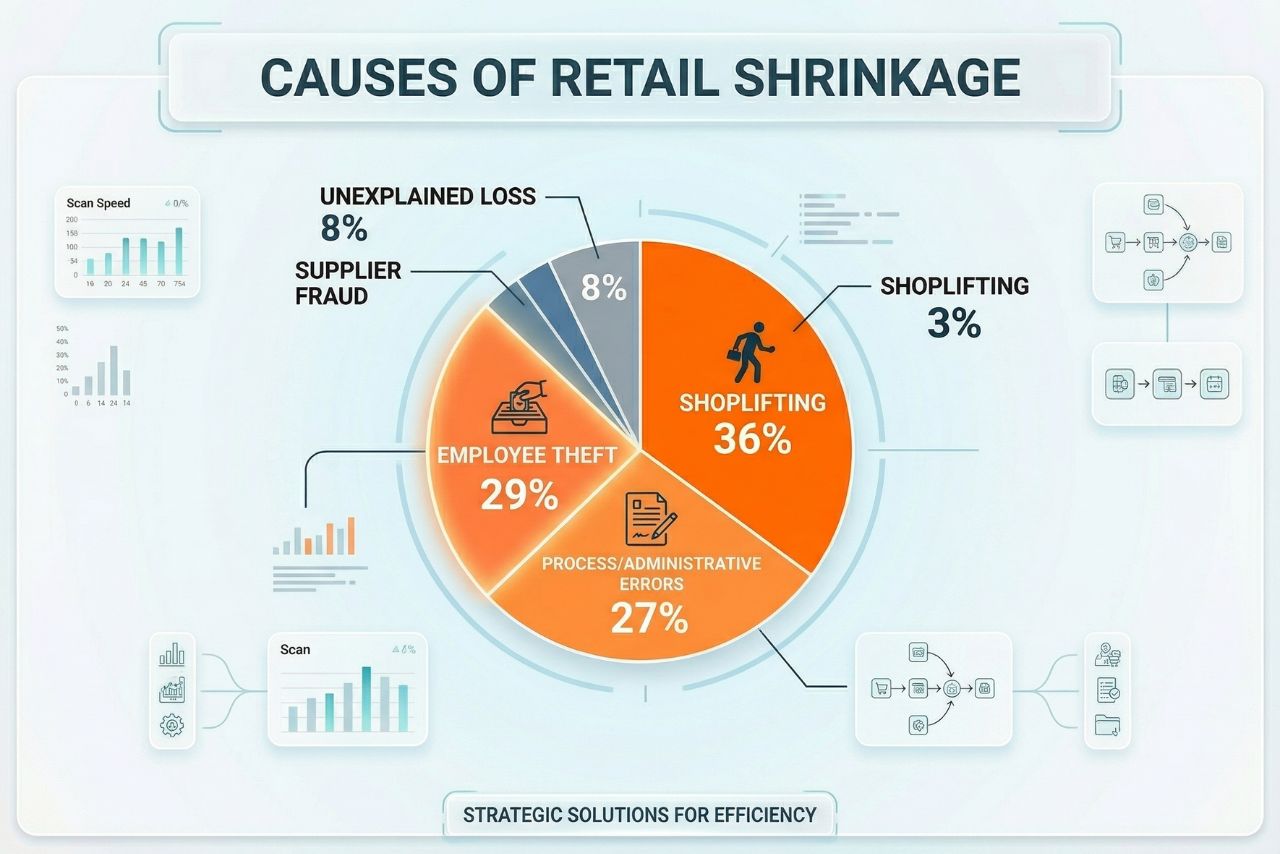
Administrative errors — receiving discrepancies, miscounts, data entry mistakes, returns processing errors — account for account for roughly 27% of total retail shrinkage depending on the operation. These are non-criminal, preventable losses that accurate scanning processes can directly address, offering a clear Return on Investment (ROI) by reclaiming lost margins without requiring massive security overhauls. This article focuses on that piece of the problem: where scanning failures create inventory gaps, and how retail chains are using tighter scanning workflows to close them.
Where the Inventory Goes: Breaking Down Shrinkage Sources
Industry data consistently points to four primary sources of retail shrinkage:
- External theft (shoplifting and organized retail crime): roughly 35–40% of shrinkage
- Employee theft: approximately 28–30%
- Administrative errors (receiving mistakes, miscounts, data entry errors, returns processing): approximately 25–28%
- Vendor fraud and supplier discrepancies: approximately 5–6%
The first two categories — external and internal theft — require loss prevention strategies, security investment, and personnel training. The third category — administrative errors — is where scanning process quality has the most direct impact. Getting scanning right doesn't eliminate theft, but it eliminates the confusion that can mask theft, and it directly removes the operational errors that drive a large share of the administrative shrinkage number.
How Inaccurate Scanning Creates Shrinkage (Even Without Theft)
Most administrative shrinkage traces back to a small number of consistent failure points:
Unscanned or misscanned items at receiving
When a shipment arrives and is checked in with shortcuts — manually keying quantities instead of scanning each item, or scanning only one case and multiplying — the system records what the team thinks arrived rather than what actually arrived. A short shipment from a supplier that isn't caught at the scan creates an immediate inventory discrepancy. Over time, these small gaps aggregate into meaningful stock inaccuracy.
Returns processing errors
Returns are one of the most error-prone processes in retail. Items returned without a scan, items returned to the wrong inventory location, items credited in the system but not physically re-shelved — each of these creates a gap between system records and physical reality. A returns workflow that requires a scan before any transaction is processed closes this gap.
Self-checkout scan gaps
Research comparing self-checkout shrinkage rates to staffed checkout lanes shows a significant difference. One study cited in retail industry coverage found self-checkout shrinkage at approximately 3.5%, compared to around 0.2% for conventional staffed lanes. While some of this is intentional theft, a portion is unintentional: items placed in the bagging area without scanning, barcodes not read cleanly, multi-item purchases where one item doesn't register. Better scanner performance at self-checkout — faster decode, more reliable reads on damaged or wrinkled codes — reduces the unintentional portion of this gap.
This is critical, as data shows self-checkout lanes experience a shrink rate of 3.5%, significantly higher than the 0.2% found in staffed lanes. In an era where retailers are re-evaluating self-checkout viability, high-performance scanning technology is the difference between a friction-free customer experience and a major loss channel.
Receiving: The First Place Shrinkage Happens
The receiving dock is the entry point for every item in your inventory system. What gets recorded here becomes the baseline against which every subsequent discrepancy is measured. In operations where receiving scanning is inconsistent — shortcuts taken during busy delivery windows, staff manually entering quantities, handheld scanners that struggle with supplier carton labels — errors that began at the dock become permanent inventory inaccuracies.
Two receiving practices that consistently reduce this source of shrinkage:
Scan-every-unit rather than count-and-enter
Requiring a scan for each individual unit (or each case, in case-pack environments) rather than visual counting and manual entry. Slower per shipment, but dramatically more accurate — and the accuracy compounds across months and stock cycles.
Real-time PO matching
Scanning against the open purchase order in the WMS or ERP as items are received. The system flags any discrepancy — wrong item, wrong quantity, unlisted item — before the receiving clerk signs off. Exceptions are caught at the moment of receiving rather than discovered weeks later during a cycle count.
Cycle Counting with Scanners: Catching Problems Before They Compound
Annual physical inventory was the industry standard for decades. It's increasingly being replaced, or at least supplemented, by more frequent cycle counting — scheduled, systematic counts of a portion of inventory on a regular basis. The logic is straightforward: a discrepancy found after six months of compounding is much harder to investigate and correct than one found six weeks after it appeared.
Mobile scanning makes cycle counting faster. Instead of paper count sheets, staff carry a rugged handheld running the inventory management software — scan the barcode, the system confirms or flags the count, move to the next item. A targeted cycle count of a product category can be completed in a fraction of the time it took with paper, which means it can happen more frequently, which means discrepancies are caught earlier.
Retail chains that have moved to weekly or bi-weekly cycle counts of their high-shrink categories — typically high-value, easily portable, or fast-moving items — consistently report better shrinkage visibility and faster identification of problem areas, whether the problem is process error, theft, or supplier issues.
POS Accuracy and the Self-Checkout Problem
POS scanning is the final transaction point, but it's also one where scanning failures translate directly into revenue loss. A barcode that doesn't scan cleanly at checkout either gets manually keyed (introducing human error), gets voided and rescanned (slowing the transaction), or — in self-checkout — may not get processed at all.
The scanner performance specifications that matter most at POS for shrinkage control:
- Decode reliability on real-world label quality — packaging that's been on shelf for months may have faded, wrinkled, or slightly damaged barcodes. A scanner that reads these cleanly without multiple attempts prevents the shortcuts (manual entry, item voiding) that introduce errors.
- Omnidirectional reading capability — reduces the number of cases where a cashier or self-checkout user misaligns the barcode and the read doesn't register.
- Clear confirmation feedback — audible beep and visual indicator confirming each successful scan reduces the probability of unintentional skip-scans, particularly at self-checkout.
What a Tighter Scanning Operation Actually Looks Like
Retail chains that have successfully used scanning process improvements to reduce administrative shrinkage tend to share a few operational characteristics:
- Receiving workflows require scan confirmation before quantity is recorded in the system — no manual entry bypass.
- Returns require a scan before any inventory transaction is processed — return credit only after physical product confirmation.
- Cycle counting is scheduled, role-assigned, and tracked — not ad hoc when time permits.
- POS scanner performance is reviewed as an operational metric, not just a hardware issue — decode failure rates and manual override frequency are tracked.
- Hardware is maintained and replaced on a proactive schedule — a scanner that's degraded to 80% read reliability because the scan window is scratched isn't saving money by staying in service.
None of these are radical changes. They're process disciplines that require consistent execution and hardware that performs reliably enough to make the process work without friction.
Key Takeaways
- Approximately a quarter to a third of retail shrinkage comes from administrative errors — receiving discrepancies, miscounts, returns processing failures — all areas where scanning process quality directly matters.
- Accurate scan-to-confirm workflows at receiving, returns, and cycle counting reduce administrative shrinkage by closing the gap between system records and physical inventory.
- Self-checkout scan accuracy is a measurable contributor to shrinkage; investing in scanner performance at self-checkout reduces the unintentional scan gap, even before considering intentional theft.