
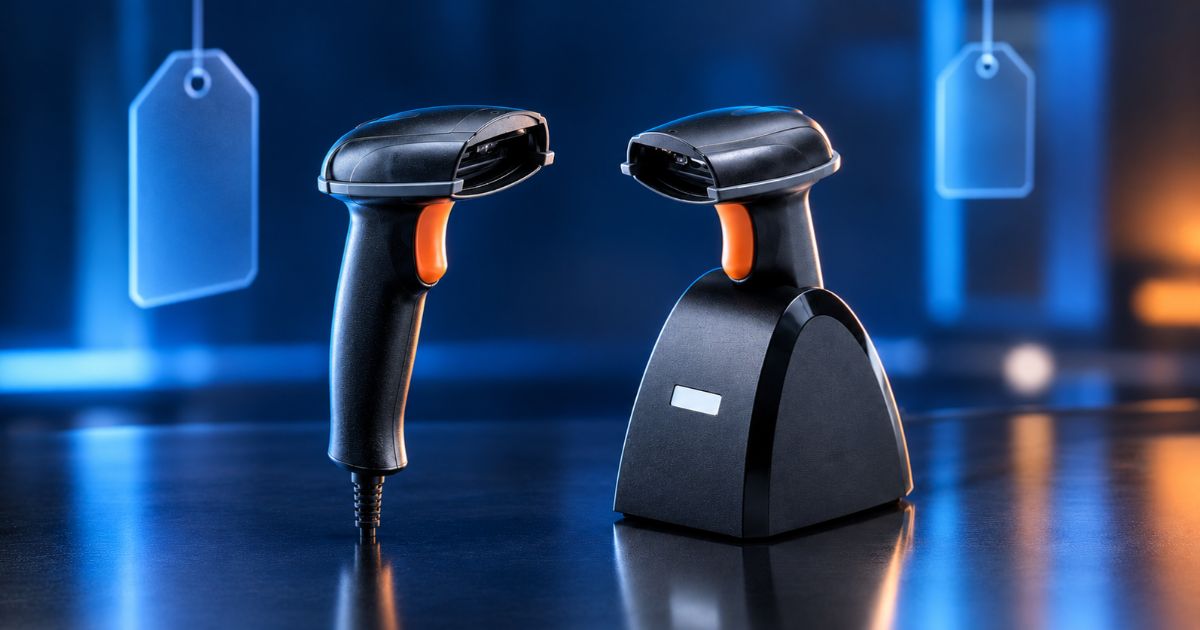
Corded vs Cordless: A Total Cost of Ownership Comparison
The Purchase Price Is Not the Cost of a Scanner
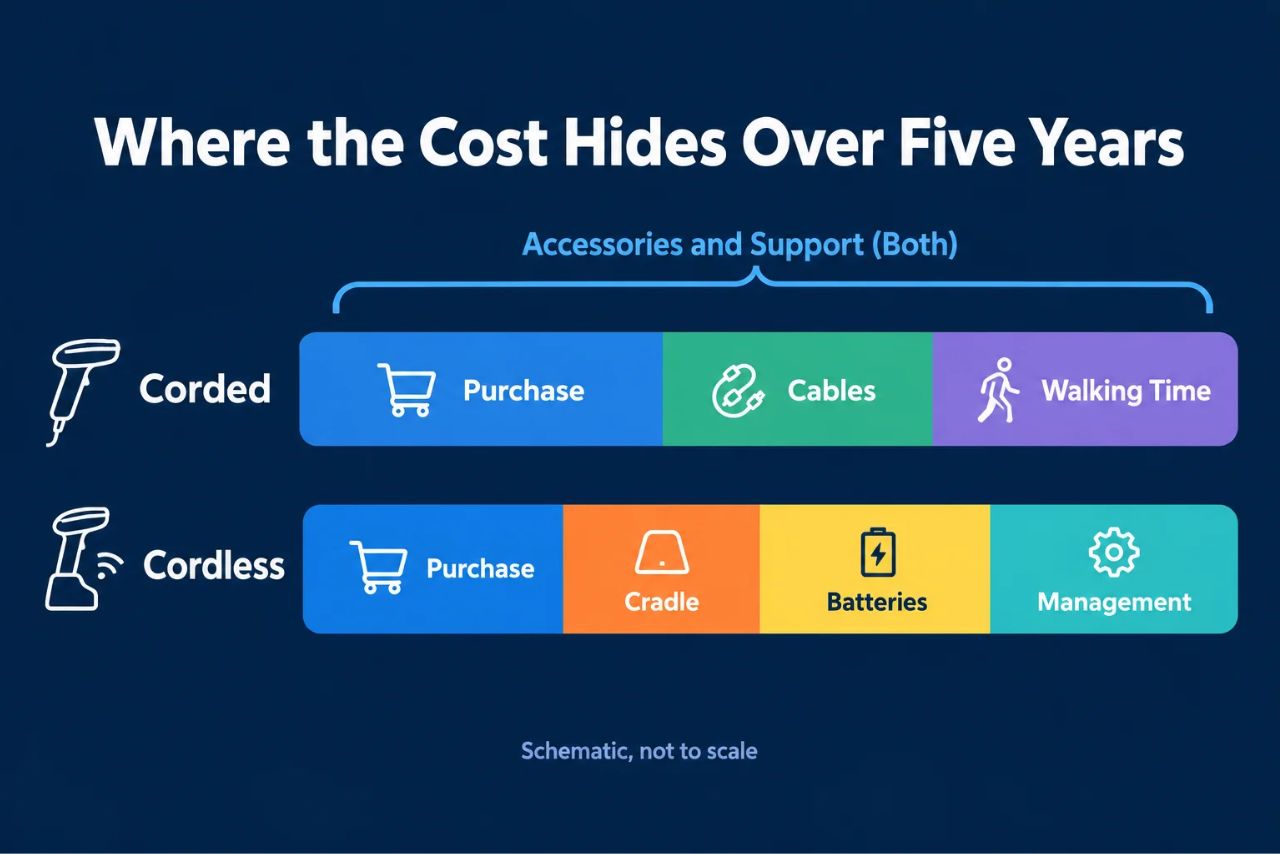
Cordless scanners carry a price premium over corded ones, and that premium is what most buying discussions start and end with. It is a small part of the picture. A scanner costs money in the cable that wears out at the connector, the battery that loses capacity, the cradle that charges it, the time a worker spends walking back to a workstation, and the support plan wrapped around all of it. Which type is cheaper to own depends on how those items add up in your workflow.
We found no independent, published total-cost study that compares corded and cordless barcode scanners. Some resellers state that corded scanners cost 20–30% less to own over three to five years in warehouses, but we could not verify the basis for that figure (Source: reseller FAQ, retrieved 2026). Instead of a number to copy, this article gives you a cost model, the sourced inputs that exist, and a worked example with stated assumptions that you can replace with your own.
| USD 2.9–3.2 B | Two publishers' 2025 estimates of the wireless barcode scanner market, P Market Research at USD 2.88 billion and Marketintelo at USD 3.2 billion. Both are small publishers, scope differs, and neither is confirmed by a larger research firm. (Sources: as named, 2025–2026) |
| 300–500 cycles | Typical charge cycles a lithium-ion cell delivers at full depth of discharge before capacity falls, against 1,200–1,500 cycles at 50% depth of discharge. Cycle life depends strongly on how deeply the battery is used. (Source: Battery University, BU-808, retrieved 2026) |
| Once a year or more | How often a scanner cable may need replacement in a high-volume receiving area, according to one reseller, who calls the connection at the scanner head the most common failure point. (Source: Advanced Automation, June 2026) |
| 10–20% / 8–15% | Accessories and spares added to device cost in a 25-device deployment (10–20%), and extended warranty or service contracts as a share of hardware value per year (8–15%). Both come from a software vendor's pricing guide. (Source: Cleverence, 2026) |
The Cost Categories on Each Side
Corded scanners
A corded scanner has no battery to replace and no charging equipment to buy, and its data path is the simplest to troubleshoot. Its costs concentrate in a few places:
- The cable. One reseller reports that the connection at the scanner head is the most common failure point and that in a high-volume receiving environment a cable may need replacing once a year or more (Source: Advanced Automation, June 2026). Cables are cheap, but replacing them costs labor and downtime.
- Reach. The cable limits how far the worker can go from the host. If the task requires walking back and forth, the cost shows up as lost time, not as a line on an invoice.
- Moves and changes. Re-routing cables or moving a workstation means cabling work, and long slack in cables creates scanning errors and tripping hazards in some layouts.
Cordless scanners
A cordless scanner trades the cable for a battery and a radio. Retailers and resellers consistently note that cordless models carry a price premium over corded equivalents (Source: ID Mart, retrieved 2026). The added costs are:
- The base or cradle. Most cordless scanners need a charging cradle, and some cradles are also the Bluetooth receiver. Our guide to Bluetooth and Wi-Fi scanner links explains how they connect.
- Batteries. A lithium-ion battery loses capacity with use and age, so it will need replacing during the scanner's life, and spare batteries add to the cost.
- Management. Pairing, firmware updates and battery tracking take time, especially across many devices.
- Charging discipline. A scanner that is not on its cradle between shifts is a scanner that stops mid-shift, and the lost time is a cost.
- Loss. A device that can walk out of the building can be misplaced or taken, which a tethered one cannot.
Costs both share
Both types need accessories and spares. A software vendor's pricing guide estimates that accessories and spares add 10–20% to device cost in a 25-device deployment, and that extended warranties and service contracts typically cost 8–15% of hardware value per year (Source: Cleverence, 2026). Both also carry training and software costs. Those are not a reason to prefer one type, but they belong in any comparison so that the totals are realistic.
Battery Economics: How Often Do You Replace Them?
Battery University, a widely cited reference, states that manufacturers conservatively specify consumer lithium-ion life at 300–500 charge and discharge cycles, and that a cell used to full depth of discharge delivers about 300–500 cycles while one used to half depth delivers 1,200–1,500 (Source: Battery University BU-808, retrieved 2026). Depth of use matters as much as the number of shifts.
A scanner's battery is often sized well beyond one shift. One cordless datasheet lists battery life of up to 100 hours, and a reseller article says most scanners can make up to 50,000 scans on one charge (Source: reseller comparison page; Legacy Global, retrieved 2026). If a worker uses only a fraction of that capacity per shift, the battery spends its life in shallow cycles, and age and heat, not cycle count, become the likelier reason to replace it. We found no published replacement-interval data specific to barcode scanner batteries, so ask each supplier for the replacement interval, the battery price and the expected number of cycles at your usage.
A Worked Example With Stated Assumptions
The numbers below are assumptions chosen for illustration. They are not market prices or measured values. Replace each one with your own and the structure still holds.
- A corded scanner costs USD 150. A cordless scanner including its cradle costs USD 300.
- The corded scanner needs one replacement cable a year. The cable costs USD 15 and a replacement takes 15 minutes of technician time at USD 30 an hour, which is USD 7.50.
- The cordless scanner needs a replacement battery in years 2 and 4. The battery costs USD 40 and the swap takes the same USD 7.50 of labor.
- The service life is five years, and the cost of support is the same for both.
Over five years, the corded scanner costs USD 150 plus five cables at USD 22.50 each, or USD 262.50. The cordless scanner costs USD 300 plus two batteries at USD 47.50 each, or USD 395. The corded scanner is USD 132.50 cheaper per unit, before any effect on productivity.
Break-even: how much time must cordless save?
Divide the USD 132.50 difference by the USD 30 hourly labor cost and you get about 4.4 hours, or about 265 minutes, over five years. At 250 working days a year, that is about 13 seconds a day. If cordless saves a worker more than roughly 13 seconds a day in this example, by avoiding walking back to a workstation or untangling a cable, it is cheaper overall. If the worker stays at one bench all day, it saves nothing, and corded wins.
The point of the example is the sensitivity, not the answer. Productivity gains dominate when they exist, and are zero when they do not. A task that sends a worker across a floor all day favors cordless. A fixed workstation favors corded. A high-volume receiving area with frequent cable failures shifts the numbers toward cordless, and a site with no charging discipline shifts them back.
How sensitive is the answer?
Change one assumption at a time and the break-even moves a long way. The table keeps every other input at its base value and varies only the one named, using the same USD 30 hourly labor rate and 1,250 working days over five years.
| Scenario (one change from the base case) | Corded, 5 years | Cordless, 5 years | Break-even time saved by cordless |
|---|---|---|---|
| Base case above | USD 262.50 | USD 395.00 | About 12.7 seconds a day |
| Cables fail twice a year, not once | USD 375.00 | USD 395.00 | About 1.9 seconds a day |
| Batteries replaced every year from year 2 | USD 262.50 | USD 490.00 | About 21.8 seconds a day |
| Cordless premium is only USD 100 | USD 262.50 | USD 345.00 | About 7.9 seconds a day |
Two things stand out. In a harsh receiving area where cables fail twice a year, the two types cost almost the same, and a second of saved time tips the choice. Where batteries age quickly, the corded scanner is the cheaper one unless the worker moves a lot. All four results are produced by the assumptions above, so they show how the model behaves, not what you will pay.
When Each Option Wins on Total Cost
Corded tends to win where the scanner stays put and uptime is non-negotiable:
- Checkout and service counters, where one worker uses one scanner at one spot.
- Fixed packing and verification benches, where the cable is short and protected.
- Continuous multi-shift stations, where a charging gap would stop the line and battery swaps add labor.
Cordless tends to win where the worker moves:
- Receiving, put-away and large-area picking, where the walk back to a host costs time.
- Environments that destroy cables, where heavy use or difficult routing causes frequent failures. One reseller notes that switching to cordless removes this failure mode from the maintenance picture (Source: Advanced Automation, June 2026).
- Mixed-task roles, where the worker needs a scanner at several places during the day.
A third option exists. Some scanners can run corded or cordless from the same unit, which gives a fixed station the reliability of a cable and a roaming task the freedom of a battery (Source: Barcode Factory blog, retrieved 2026). Our comparison of wired and wireless scanners covers the functional trade-offs in more detail.
Costs That Do Not Fit a Spreadsheet Cell
Some costs are real but hard to price. A scanner that fails during a shift stops the person using it, and research on mobile devices has put the lost worker time at between 52 and 80 minutes per failure for tablets (Source: VDC Research, cited in a DT Research press release, 2018). That study is not about scanners, but it shows the scale of the effect, and it is why a spare pool of a few units is worth more than the same money spent on one more premium device.
Security and control also differ. A cordless scanner pairs with a receiver, so you should decide how pairing is recorded and reset, and what happens when a scanner is lost. A corded scanner is tied to a port, which is simple but ties the worker to that spot. Neither is a reason to choose one type on its own, but each belongs on the list of questions you answer before you compare totals.
Finally, think about the replacement cycle. If all batteries in a fleet were bought on one day, they will fail at about the same time, and so will all the cables bought with a batch of corded scanners. Staggering purchases, or buying a few spares each year, spreads the cost and avoids a month in which half the scanners stop at once.
How to collect your own numbers
- Keep a failure log for 90 days: device model, location, cause, repair time and parts used, for both cables and batteries.
- Sample the walk. Observe a few workers for a shift and count how often a cable forces them back to a host or into a detour.
- Check battery health on a sample of devices that are a year or two old, and ask the supplier how replacement is measured.
- Price the accessories you actually use, including cradles, chargers, mounts and spare batteries, and add them to the model for both types.
Questions to Ask When Comparing Total Cost
- How many hours a day does each worker walk away from the host because of the cable, and what is an hour worth?
- How often do cables fail in our environment, and what does one failure cost in parts and labor?
- What is the battery's replacement interval, price and expected life at our usage, and who swaps it?
- What must we buy besides the scanner: cradles, chargers, spare batteries, cables, mounts?
- How will we make sure scanners are charged between shifts, and what happens if one is not?
- Who pairs, updates and tracks the cordless devices, and how much time does that take?
- What does the support plan cost per year, and does it cover batteries and cables?
- Over the realistic service life, what is the total for each option once our own numbers replace the assumptions in the example?
Count the Time, Not Just the Parts
Corded and cordless scanners differ in purchase price, in what wears out and in how much a worker can move. The parts add up to a small number, and the example above showed that the difference can be a few hundred dollars per unit over five years. The question that decides the comparison is whether the cable costs your workers time.
Measure that directly: watch a few workers over a shift, count how often the tether forces a detour, and price it. Then add cables, batteries, accessories and support from your own records. That total, not the sticker price, is what you will actually pay.
Keep the model alive after the purchase. Re-run it once a year with the failure log, the battery replacements you actually made and the accessories you actually bought. If the real cable and battery costs differ from your first assumptions, the comparison may change, and a mixed fleet with corded units at fixed stations and cordless units for roaming roles is often where the numbers settle.
Frequently Asked Questions
Are cordless barcode scanners more expensive to own than corded ones?
Cordless scanners carry a price premium and add a cradle and batteries, while corded scanners add cables that wear out. We found no independent total-cost study. In our worked example, with stated assumptions, the corded scanner was USD 132.50 cheaper per unit over five years before any effect on productivity, and cordless came out ahead if it saved a worker more than about 13 seconds a day.
How often do barcode scanner cables need replacing?
One reseller reports that the connection at the scanner head is the most common failure point and that in a high-volume receiving area a cable may need replacing once a year or more (Source: Advanced Automation, June 2026). The interval depends on how heavily the scanner is used, how the cable is routed and how it is handled.
How long does a cordless scanner battery last?
A lithium-ion cell typically delivers 300–500 cycles at full depth of discharge and 1,200–1,500 at 50% depth (Source: Battery University, BU-808). Scanner batteries are often sized well beyond one shift, so most cycles are shallow and age and heat matter as much as cycle count. We found no published replacement-interval data for scanner batteries, so ask the supplier.
When does a corded scanner beat a cordless one?
Corded tends to win where the scanner stays put and uptime is essential, such as checkout counters, fixed packing benches and continuous multi-shift stations. Cordless tends to win where the worker moves, such as receiving, put-away and large-area picking, and in environments that destroy cables.
Scanning in a demanding environment?
Share your operating conditions, and we'll give you an honest view of what fits.
Explore ALVICS Products →