

The Rise of Wearable Scanners: Is Hands-Free Really the Future?
What Counts as a Wearable Scanner, and What Do We Actually Know?
A wearable scanner is a barcode reader worn on the finger, hand, wrist or head so that the worker's hands stay free to lift, pack and sort. The logic is simple: each time a picker puts a handheld scanner down during order picking to move a carton, a second or two disappears, and across a shift that can matter for warehouse productivity. The open question is whether that saving is large and reliable enough, across very different operations, to call hands-free scanning "the future" for the whole category.
This article separates the main form factors (ring and glove scanners, smart glasses and voice headsets), then looks at what market research, sponsored surveys and independent tests say about each. It covers comfort and worker acceptance, and it ends with a decision guide, a pilot method and questions for suppliers. We found no independent installed-base figures for wearable scanners and no independent production-scale trial of ring or glove scanners. Most productivity numbers come from vendor-funded surveys, vendor case studies or very small pilots, and the text flags each one.
| 6.1–7.7% | Annual growth forecast for the wearable barcode scanner market across four research firms: Global Info Research 6.1%, LP Information 6.4%, DIResearch 6.33% and 360iResearch 7.71%. Their 2024–2025 size estimates differ by roughly 70 to 90 times, from USD 15.3–18.69 million to USD 1.32 billion, because scopes differ. (Sources: as named, 2025–2026) |
| 32.3% | Average improvement in order-fulfillment speed reported by respondents in a VDC Research survey of 175 warehouse technology decision-makers, commissioned by wearable scanner maker ProGlove. Self-reported; 85% said payback took eight months or less. (Source: VDC Research whitepaper on behalf of ProGlove, 2022) |
| 40 people | Participants in an independent, peer-reviewed lab test of a wand scanner, a ring scanner and smart glasses. The ring and wand scanners performed comparably and were rated most comfortable; the glasses were least productive and least comfortable. (Source: Gaddis et al., International Journal of Industrial Ergonomics, 2022) |
| 54–64% | Share of warehouse decision-makers planning to adopt wearable computers and devices within one to five years, in a Zebra-commissioned study of more than 1,700 respondents. The report's chart shows 54% and its text says 64%; the category is broader than scanners. (Source: Zebra Warehouse Vision Study, 2024) |
| Form factor | What it frees up | What the evidence shows | What to watch |
|---|---|---|---|
| Handheld scanner (baseline) | Nothing; one hand holds the device | A redesigned handheld that reduced wrist tilting raised productivity 14% in earlier research (Source: Nair et al., 2018, as cited in Gaddis et al., 2022) | Picked up and put down on every two-handed task |
| Ring scanner (finger-worn) | Both hands | Performed comparably to a wand scanner and was among the most comfortable devices in a 40-person lab test (Source: Gaddis et al., 2022) | Usually paired with a wrist-worn computer or similar device (Source: US Patent 9,224,027, retrieved 2026); fit across hand sizes |
| Glove or hand-mounted scanner | Both hands | A two-participant pilot run for ProGlove reported 11.5% faster shelf picking and less wrist flexion than handheld and ring scanners (Source: ProGlove press release on a Fraunhofer IPA pilot, 2023) | Sponsor-funded, tiny sample; check fit, cleaning and glove compatibility |
| Smart glasses (head-worn display) | Both hands, with instructions in view | DHL reported a 15% average gain in its own pilots (Source: DHL Supply Chain, 2017); glasses were least productive and least comfortable in the 40-person lab test (Source: Gaddis et al., 2022); a review of 28 studies found contrasting results (Source: Bal et al., 2021) | Eye, neck and shoulder discomfort grew over time in the lab test; one glasses model was tested |
| Voice picking headset | Both hands and eyes; no scan unless added | A vendor says replacing paper picking with voice typically brings a 10–15%+ productivity gain (Source: Honeywell, 2020) | Vendor figure for a paper baseline; compare with scanning in your own aisles |
The Market: Growing Steadily, but Hard to Size
Four research firms publish estimates for the wearable barcode scanner market, and they disagree by a factor of roughly 70 to 90. Three put 2024–2025 sales at USD 15–19 million: Global Info Research USD 15.3 million for 2024, LP Information USD 16.4 million for 2025 and DIResearch USD 18.69 million for 2025. 360iResearch values the market at USD 1.32 billion in 2025. The free report summaries do not publish their definitions, but the 360iResearch listing names handheld and cordless mountable scanners among its product types, next to wearable ring scanners, which suggests a broader scope. We could not verify any of the scopes (Source: report summaries on MarketResearch.com and GII Research, retrieved 2026).
| Research firm | Year | Estimated size | Forecast growth |
|---|---|---|---|
| Global Info Research | 2024 | USD 15.3 million | 6.1% a year to 2031 |
| LP Information | 2025 | USD 16.4 million | 6.4% a year, 2025–2031 |
| DIResearch | 2025 | USD 18.69 million | 6.33% a year, 2025–2032 |
| 360iResearch | 2025 | USD 1.32 billion (product types include handheld and cordless mountable scanners) | 7.71% a year, 2025–2032 |
Growth forecasts sit closer together, at 6.1% to 7.7% a year. That is in line with whole-market forecasts rather than far above them: 360iResearch puts its overall barcode scanner market at USD 8.04 billion in 2025, growing 7.30% a year to 2032, and Technavio forecasts 9% a year for 2024–2029 (Source: 360iResearch, 2025; Technavio, 2025). For scale, dividing the three small estimates by IMARC's USD 7.8 billion total for 2025 gives about 0.2% of scanner spending, while 360iResearch's own figures give about 16% (Source: IMARC, 2025; our arithmetic). Those ratios mix publishers and scopes, so read them as a picture of the uncertainty, not as a market share.
Surveys point the same way without settling the question. In a Zebra-commissioned global study of more than 1,700 warehouse associates and decision-makers, wearable computers and devices ranked last of five device categories for planned adoption within one to five years. The report's chart shows 54%, while its text says 64% (Source: Zebra Warehouse Vision Study, 2024). The category also includes wearable computers, not only scanners. In a 2022 survey for ProGlove, VDC Research estimated that investment in wearable scanning, across all form factors, would rise 27% in 2022 (Source: VDC Research, 2022). A one-year spending plan from a sponsored survey is not a measure of market size.
Productivity: Large Claims, Little Independent Evidence
What sponsored research reports
The most-cited figures come from a VDC Research survey of 175 warehouse technology decision-makers, produced on behalf of ProGlove. Respondents reported average gains of 32.3% in order-fulfillment speed, 30.9% in order-fulfillment accuracy and 27.2% in picking and packing accuracy, and 85% reported payback in eight months or less (Source: VDC Research whitepaper on behalf of ProGlove, 2022, as reported by Industry Today). These are respondents' own estimates. ProGlove's summary attributes the gains to organizations using its technology, and we could not read the full whitepaper to see how gains were measured or which products respondents ran.
A pilot by the Fraunhofer Institute for Manufacturing Engineering and Automation IPA, run on behalf of ProGlove, recorded motion and muscle activity for two participants. It reported glove scanners 11.5% faster on shelf picking than the ring and handheld scanners tested, with less wrist flexion and extension (Source: ProGlove press release on the Fraunhofer IPA pilot, 2023). With two participants, the result shows a direction worth testing, not an effect size to plan around.
DHL Supply Chain reported an average 15% productivity gain, higher accuracy and halved onboarding time in its smart-glasses pilots, often called vision picking (Source: DHL Supply Chain press release, 2017). That is an operator's own report of a pilot, for glasses that show picking instructions rather than only scanning, and it is not a controlled comparison.
What an independent lab test found
One peer-reviewed study compared a wand-style handheld scanner, a ring scanner and smart glasses with 40 healthy participants, mean age about 23, who loaded and unloaded weighted boxes in a mock freight container. The authors declared no competing interests (Source: Gaddis et al., International Journal of Industrial Ergonomics, 2022). Participants were more productive with the ring and wand scanners than with the glasses, and they rated the ring and wand most comfortable. The paper's highlights describe the ring scanner as performing comparably to the wand scanner, not clearly ahead of it. The authors advise companies to keep using ring or wand scanners and say smart glasses need improvement first.
The study has limits. The task was simulated, the participants were young and healthy, and each device type was represented by one model. The glasses were a Vuzix M100, so results may not carry over to newer glasses. Even so, it is the only independent comparison of these three device types we found.
Why the numbers differ
Our reading, which is editorial analysis rather than measured fact, is that three things explain much of the gap. First, the task: the lab test involved heavy two-handed lifting, and put-down time matters little when a worker scans only now and then. Second, selection: sponsored surveys ask organizations that chose or evaluated wearables, which can favor good news. Third, bundled change: a wearable rollout often arrives together with a new warehouse management system (WMS) or a redesigned process, so the device gets credit for gains it did not cause.
Earlier research cited in the lab study found a 14% productivity gain from a redesigned handheld that removed wrist tilting (Source: Nair et al., 2018, as cited in Gaddis et al., 2022). A gain of that kind can come from cutting wasted motion even when the worker still holds the device. The same caution applies to accuracy claims; our article on Does Scan-to-Verify Reduce Pick Errors? What the Evidence Shows looks at what evidence supports error reduction in picking.
Comfort and Acceptance: Hands-Free Is Not Automatically Comfortable
In the 40-person test, participants completed comfort and body-discomfort ratings every 20 minutes. Discomfort with the smart glasses grew over time, in the eyes, neck and shoulders, while the ring and wand scanners were rated most comfortable (Source: Gaddis et al., 2022). Head-worn displays also raise a job-design question. A 2021 systematic review of 28 studies found both increases and decreases in job demands and job control, and it distinguished a supportive way of deploying the devices from a directive one (Source: Bal et al., Applied Ergonomics, 2021). That review covers head-worn displays in general, not only scanning.
Acceptance also depends on people. Fourteen focus-group interviews on wearable technology in manufacturing found hesitation about how devices and the data they collect would be used, and they also named comfort, safety, convenience, cost and culture as factors (Source: Strawderman et al., International Journal of Industrial Ergonomics, 2022). In practice, involve pickers before purchase and tell them what the device records.
On injury risk, the evidence we found is thin. The two-participant Fraunhofer IPA pilot reported lower wrist flexion and muscle activity with a glove scanner than with a handheld, but it was funded by the vendor. We found no independent study of injury rates comparing wearable and handheld scanning.
Where Hands-Free Earns Its Place: A Decision Guide
The task, not the device, decides whether hands-free is worth testing. Five questions narrow it down:
- How many scans per hour? The saving is seconds per scan multiplied by scans. As an illustration, suppose a picker makes 400 scans an hour over an 8-hour shift, which is 3,200 scans. If a wearable saves 1 second per scan, that is 3,200 seconds, about 53 minutes a shift. At 0.25 seconds per scan it is about 13 minutes. At 100 scans an hour (800 scans), 1 second per scan is also about 13 minutes. The scan rates and seconds saved are assumptions for the example, not measurements.
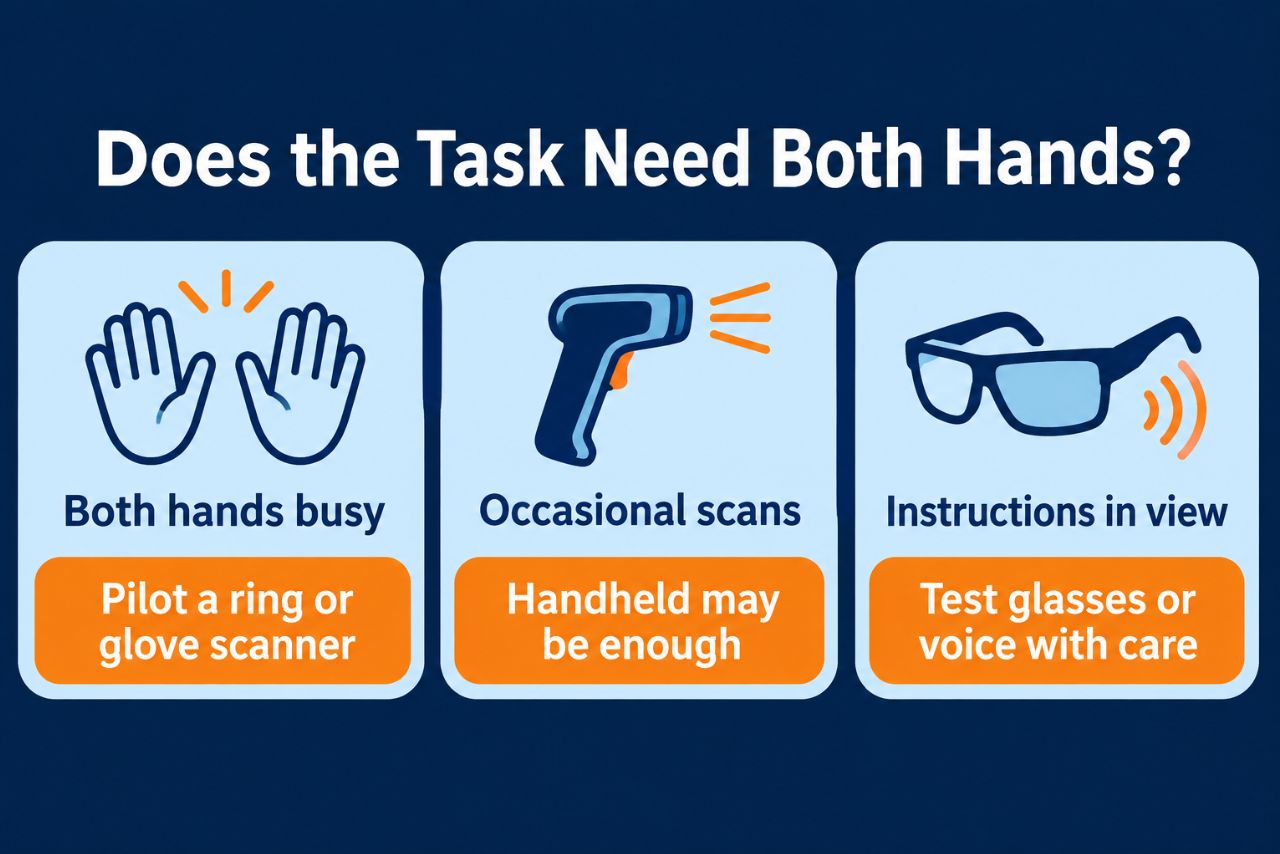
- Are both hands busy on every pick? Cartons, bulky items and two-handed packing are where the lab test and most vendor claims sit. Where a worker scans occasionally with a free hand, a handheld may be enough.
- Do gloves or cold apply? Gloves change how triggers and keys are used, and freezer work adds its own failure points, covered in our article on how cold chain operators keep scanning accurate at -25 °C.
- Do pickers need instructions in view? A ring or glove scanner relies on a separate display, such as a wrist-worn computer. Glasses and voice headsets put instructions in view or in the ear, but the evidence above is mixed for glasses and vendor-based for voice.
- What will it pair with? Many wearable scanners connect to a mobile computer or terminal, so the choice interacts with that hardware. Our article on mobile computers and dedicated scanners looks at where that market is heading.
Handheld scanners stay sensible when scans are occasional, when devices are shared among many workers with different hand sizes, or when the hand is rarely busy. In those cases the seconds saved per scan add up to little. For a broader view of device selection in warehouse work, see our guide to barcode scanners for warehouse and logistics.
How to Pilot Wearable Scanners Before You Roll Out
Published figures cannot tell you what will happen on your floor. A short pilot, run by the people who will use the devices, answers more than a whitepaper:
- Baseline first. On the highest-volume task, record seconds per scan, picks per hour and first-read rate (the share of scans that read correctly on the first attempt) with your current handheld scanners.
- Test each form factor with the same pickers over several shifts, and rotate the order so that learning does not favor the last device tested.
- Rate comfort at fixed intervals, as the lab study did every 20 minutes, and ask pickers where they feel strain.
- Cover real conditions: different hand sizes, the gloves you actually use, and your cleaning routine.
- Log the unglamorous events: battery swaps, dropped connections, time to re-pair, and lost or damaged devices.
- Repeat the baseline on another day to see normal variation, and treat a gain smaller than that variation as no gain.
Questions to Ask a Wearable Scanner Supplier
- Which form factors and trigger styles are available, and how do they fit different hand sizes and gloves?
- What does the scanner pair with (mobile computer, wrist or belt computer, WMS terminal), and what happens when the connection drops?
- What battery runtime is rated for your shift length and temperature, and how are batteries swapped or charged?
- How are scan range and first-read rate specified, and on which labels were they tested?
- Which independent or customer-run tests support the productivity figures, and who funded them?
- How are the devices cleaned, and what drop and ingress ratings apply?
- What data does the device record, and who can see it?
- What is the warranty, how are lost or damaged units replaced, and what is the plan for shared devices?
Hands-Free Is a Tool for Specific Tasks, Not a Foregone Conclusion
The evidence supports a narrow claim. For work where both hands are busy and scans are frequent, ring-type wearables are plausible, and sponsored surveys, small pilots and one independent lab test all point toward at least no loss in productivity. The evidence does not support the broader claim that hands-free will replace handheld scanning. Market estimates differ by a factor of roughly 70 to 90, forecast growth is in line with the overall scanner market, and the only independent comparison found a ring scanner roughly equal to a wand and smart glasses behind both.
Treat hands-free as a hypothesis to test on your own tasks. Measure seconds per scan, first-read rate, comfort and uptime against your current handhelds, and let those numbers, not the word "future", decide.
Frequently Asked Questions
Are wearable barcode scanners faster than handheld scanners?
Sometimes, but independent proof is thin. A vendor-commissioned survey reported 32.3% faster order fulfillment, yet a 40-person independent lab test found a ring scanner performing about the same as a wand scanner. Gains depend on how often scans happen and whether both hands are busy, so measure seconds per scan in a pilot.
How big is the wearable barcode scanner market?
Estimates for 2024–2025 range from about USD 15–19 million to USD 1.32 billion, depending on the research firm and its scope. Forecast growth is more consistent, at 6.1% to 7.7% a year. Treat any single figure with caution and check which device types a report counts.
Are smart glasses better than ring scanners for picking?
Not in the one independent test we found. In a 40-person lab study, smart glasses were the least productive and least comfortable option, while ring and wand scanners did better. DHL reported a 15% average gain in its own glasses pilots, which guided pickers rather than only scanning. Test on your own tasks.
When is a handheld scanner still the better choice?
When scans are occasional, devices are shared among many workers or the hand is rarely busy, the seconds saved per scan add up to little. A redesigned handheld that cut wrist tilting also raised productivity 14% in earlier research, so a better handheld is a fair comparison.
Scanning in a demanding environment?
Share your operating conditions, and we'll give you an honest view of what fits.
Explore ALVICS Products → Warehousing Solutions →