
Barcode Scanning in Healthcare: Is It Really the Fastest-Growing Segment?
A Growth Claim Worth Checking
Healthcare is often described as the fastest-growing segment of barcode scanning. The claim is easy to repeat and harder to support. Published market estimates for healthcare scanners differ by a factor of ten in size, depending on whether they count scanners alone, scanners with printers or software, or handhelds that include RFID, and their growth forecasts overlap with those for the market as a whole. On the data we could find, healthcare is not clearly the fastest-growing segment.
That does not make healthcare unimportant. It is one of the most safety-driven and regulated settings for scanning, and in the United States the core use, scanning at the bedside, is already almost universal. This article looks at what the market data shows, where the strongest safety evidence comes from, why adoption is close to saturation in US hospitals, how unique device identification (UDI) rules shape scanning, and what to ask when you buy. Where only a research publisher or a supplier supports a statement, the text says so.
| 3.0–8.95% | Annual growth estimates for healthcare barcode scanning from four publishers (LP Information 3.0%, Lucintel 6.8%, HTF Market Intelligence 8.9%, Straits Research 8.95%), against 5.9–8.2% for the whole barcode scanner market (IMARC, Market Research Future, Coherent Market Insights). The ranges overlap, and the segments are defined differently. (Sources: as named, 2025–2026) |
| 98.7% / 34.5% | Share of about 2,000 US hospitals in a Leapfrog Group survey with a bar-code medication administration system in place, and share meeting all four Leapfrog requirements for using it effectively, including scanning both codes in 95% of administrations. Survey data from 2017. (Source: Leapfrog Group via Castlight Health, 2018) |
| 41% / 51% | Relative reductions in non-timing medication administration errors and in potential adverse drug events after one academic medical center introduced bar-code medication administration. A single-site study, and 20% of administrations on the scanning units skipped the scan. (Sources: Poon et al., New England Journal of Medicine, 2010; AMA Journal of Ethics, 2011) |
| 92.6% | Share of US hospitals that use barcode scanning when restocking automated dispensing cabinets, in the ASHP 2023 national survey of pharmacy practice. (Source: ASHP, 2023) |
| About 86% | Share of unique device identifiers in the FDA's device database that used a GS1 Global Trade Item Number as their identifier, as reported in 2020. (Source: Medical Design Briefs, 2020) |
What the Market Data Does and Does Not Show
The estimates we found do not measure the same thing, which is why they cannot be lined up to rank segments. The table shows four of them.
| Publisher | What it measures | 2025 size | Forecast growth |
|---|---|---|---|
| LP Information | Barcode scanners for healthcare | USD 139 million | 3.0% a year, 2025–2031 |
| Straits Research | Healthcare barcode readers | USD 453 million | 8.95% a year, 2025–2033 |
| HTF Market Intelligence | Healthcare handheld scanners, including RFID | USD 1,420 million | 8.9% a year, 2026–2034 |
| Lucintel | Healthcare barcode technology | Not stated in the summary | 6.8% a year, 2025–2031 |
The sizes differ by about tenfold because the definitions do. For the whole market, IMARC reports USD 7.8 billion for 2025 with growth of 5.89% a year to 2034, Market Research Future 6.9% a year, and Coherent Market Insights 8.2% a year to 2032 (Source: IMARC, Market Research Future and Coherent Market Insights, 2025–2026). Healthcare estimates from 3.0% to 8.95% sit on both sides of those figures.
Two details are more informative than the headline. HTF reports that, within healthcare handhelds, RFID is the fastest-growing sub-segment, and that Asia-Pacific is the fastest-growing region at 10–13% a year (Source: HTF Market Intelligence, 2026). Growth in healthcare scanning therefore looks regional and technology-specific, not uniform. These are paid-report summaries from research publishers of varying size, and we could not check the methods.
A practical way to read market reports is to look at what each one counts before looking at its growth rate. Check whether it includes printers, software, RFID readers or services, whether it covers hospitals only or also clinics and laboratories, and whether the base year and forecast period match the others you are comparing. A report whose scope you cannot see is a weak basis for a budget or for a claim in a business case.
Where the Safety Evidence Comes From
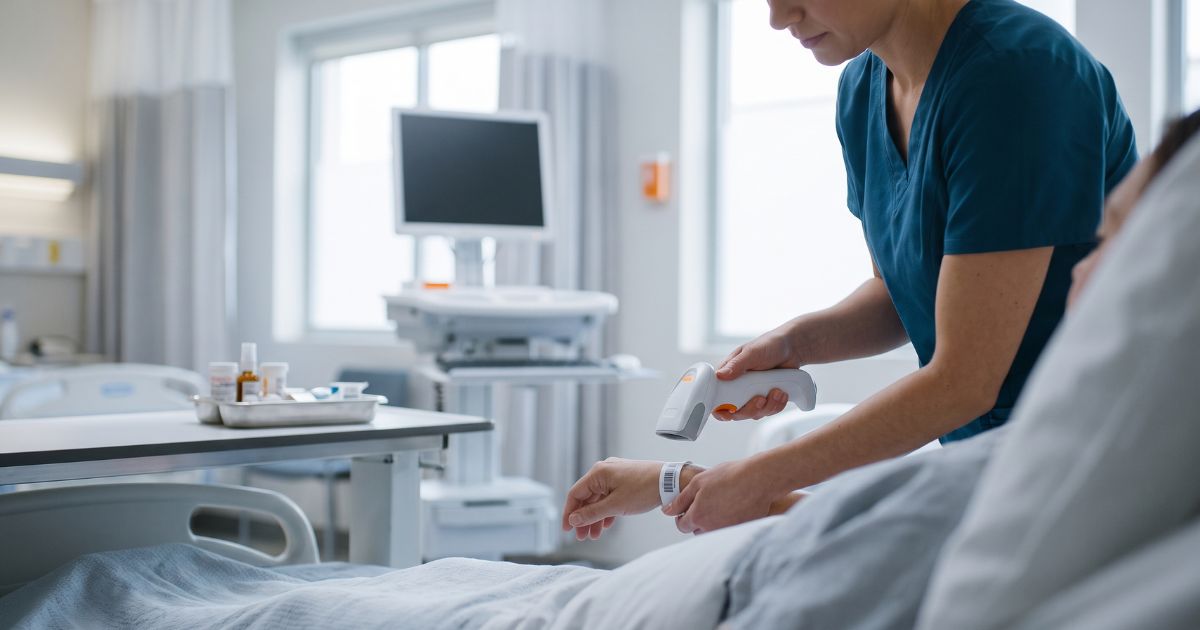
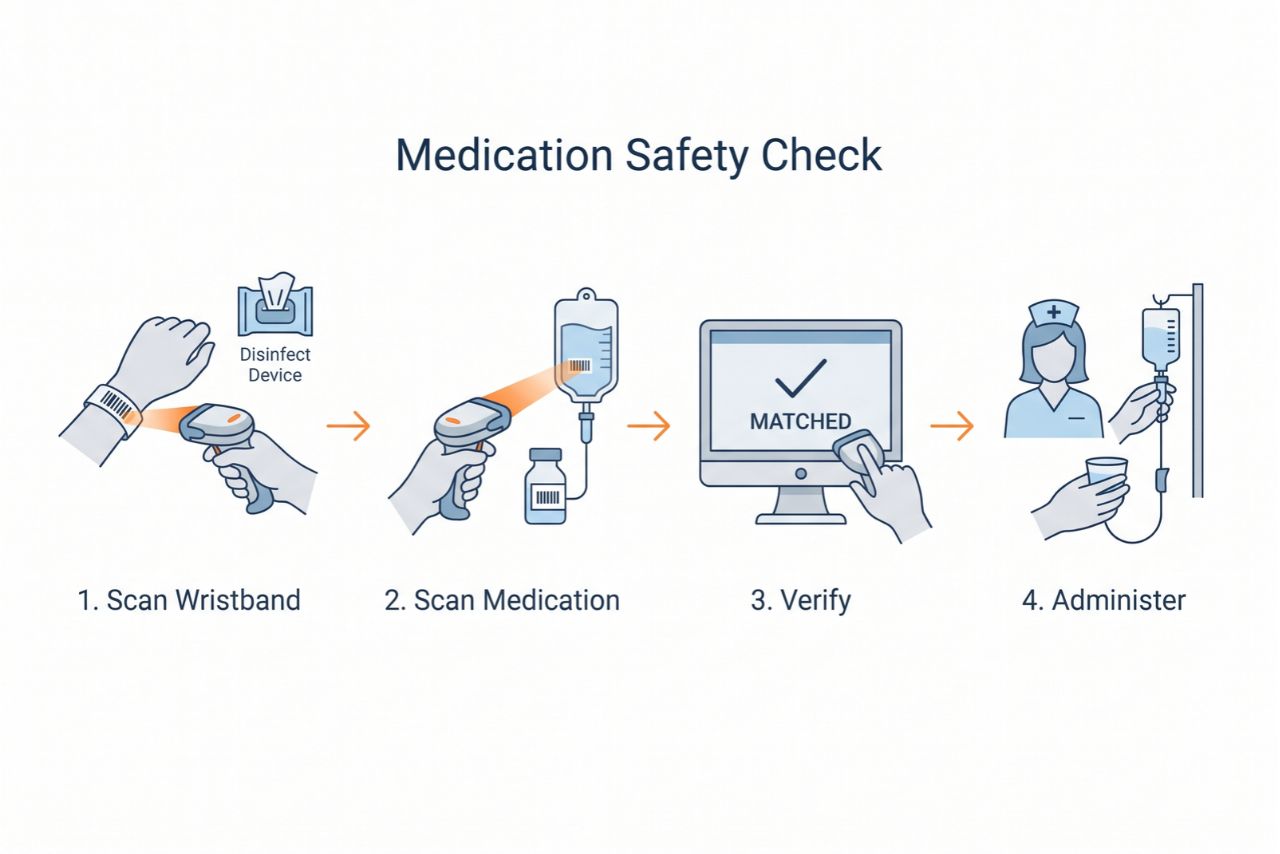
The strongest evidence for scanning in hospitals concerns bar-code medication administration (BCMA). In a bar-code electronic medication administration record, a nurse scans the code on the patient's wristband and the code on the medication before giving it, and the system checks the match.
In a study at Brigham and Women's Hospital in Boston, published in the New England Journal of Medicine in 2010, researchers observed 14,041 administrations on units with and without the technology. Non-timing errors fell from 11.5% to 6.8%, a 41.4% relative reduction. Potential adverse drug events related to those errors fell from 3.1% to 1.6%, a 50.8% reduction. Transcription errors fell from 6.1% to zero (Source: The Hospitalist, 2010; Poon et al., NEJM, 2010).
The study has limits that matter when you read the numbers. It took place at one academic medical center that already had computerized prescriber order entry and barcode checks in its pharmacy, and it counted potential, not actual, adverse events (Source: The Hospitalist, 2010). It also found that 20% of administrations on units with the technology happened without the scanning step (Source: AMA Journal of Ethics, 2011). A literature review reported that nurses believed errors were less likely with BCMA but also felt it took more time than paper (Source: Macquarie University review, 2013). The benefit is real where scanning happens, and it shrinks when people bypass it.
A scan only verifies what the system knows. BCMA requires every medication package to carry a bar code the scanners can read and every ordered medication to be listed in the electronic record (Source: Macquarie University review, 2013). That puts demands on the pharmacy and on supplier labeling as well as on the bedside scanner, and it is one reason implementations take time. A scanner that reads well cannot compensate for a package with no code or a record with a missing order.
Adoption Is Close to Saturation, So Where Is the Growth?
In US hospitals, the purchase decision has largely been made. A Leapfrog Group survey analysis found that 98.7% of nearly 2,000 hospitals had BCMA technology in place, and the ASHP reported in 2016 that about 93% of hospitals used BCMA systems (Source: Leapfrog Group via FierceHealthcare, 2018; Pharmacy Times, 2016). The ASHP's 2023 survey found that 92.6% of hospitals used barcode scanning during automated dispensing cabinet restocking (Source: ASHP, 2023).
Adoption is not the same as effective use. In the same Leapfrog analysis, only 34.5% of hospitals met all four requirements for effective use, and 42% fell short of the standard of scanning both codes in at least 95% of bedside administrations (Source: Leapfrog Group via Healthcare Dive and MedTech Dive, 2018–2019). Demand in a mature market therefore comes from places other than first-time adoption. Based on the evidence above, the candidates are:
- Compliance and workflow. Closing the gap between having a system and using it every time, which depends on scanners that read reliably at the bedside.
- Other clinical workflows, such as specimen labeling, blood products, nutrition and pharmacy. The market-report outlines we reviewed list these as application areas, though we found no figures for them.
- Technology refresh, including 2D scanners and RFID, which one publisher identifies as the fastest-growing healthcare handheld sub-segment.
- Geography, where one publisher reports Asia-Pacific growing fastest.
This list is a reading of the sources, not a forecast. It explains why the market can be critical to patient safety and still not be the fastest-growing segment by revenue.
Regulation: How UDI Shapes Scanning
UDI rules affect scanning on the supply side. The US FDA published its Unique Device Identification rule in September 2013 and phased in compliance by device class from 2014. For Class I and unclassified devices, the FDA's last labeling and direct-marking enforcement date was 24 September 2022, and it did not intend to enforce database submission for them before 8 December 2022 (Source: FDA, retrieved 2026). A UDI must come from an FDA-accredited issuing agency, and there are three: GS1, HIBCC and ICCBBA (Source: Registrar Corp, retrieved 2026). About 86% of the UDIs in the FDA's database used a GS1 Global Trade Item Number as the product identifier in 2020 (Source: Medical Design Briefs, 2020).
The EU follows a similar path under its Medical Device Regulation. The European Commission's UDI helpdesk lists 26 May 2025 as the deadline for UDI carriers on the labels of Class I devices and 26 May 2027 for direct marking of reusable Class I devices (Source: European Commission UDI Helpdesk, retrieved 2026). Direct marking matters for scanning because a mark on a reusable instrument is a direct part mark, which is harder to read than a printed label and may need a scanner that can read it.
For a hospital, the practical result is more machine-readable data on more items, in more than one format. Scanners and software should read the formats that GS1, HIBCC and ICCBBA use, and the 2D symbols that fit on small items. Check the formats the scanner supports against the formats your suppliers actually use.
What Healthcare Scanners Must Do Differently
The published sources we reviewed do not set a standard specification for healthcare scanners, so the points below are questions to put to a supplier, not requirements we can cite.
- Cleaning and disinfection. The housing, window and seals face frequent wiping. Ask which disinfectants the housing is tested against, and what the replacement cost is for parts that wear first. An IP code does not cover chemicals (see our guide to IP ratings for industrial scanners).
- Reading difficult codes. Wristbands are curved and sometimes wet, medication labels are small, and some codes are 2D. Ask for read results on your own wristbands and on your own medication packaging.
- Speed at the bedside. If scanning is slow or fails, workers bypass it, as the 20% skip rate in the Brigham study shows. First-read rate and time to read are safety measures here.
- Lighting and noise. Patient rooms are often dim at night, and a loud beep can disturb patients. Ask about illumination, beep volume and the option of a quieter signal.
- Battery and charging. A scanner that dies mid-round invites a workaround. Ask for a full-shift runtime and for how charging fits infection-control routines.
- Connectivity. Wireless dead spots in patient areas produce failed scans. See our comparison of Bluetooth and Wi-Fi scanners for how to think about coverage.
Making Scanning Reliable at the Bedside
The Leapfrog data points to the most useful lever: the proportion of administrations in which both codes are scanned. A hospital can measure it, and the target of 95% gives a concrete benchmark (Source: Leapfrog Group, retrieved 2026).
- Track scan rates and overrides by unit and by shift, and ask why scans are skipped. A high override rate often points to a problem with the device, the label or the network, not with the staff.
- Check wristband and label print quality. Barcode print quality is graded under ISO/IEC 15416 for linear symbols and ISO/IEC 15415 for 2D symbols (Source: GS1 support, 2024). Verify printed wristbands, not only the template.
- Survey the wireless network with the actual devices in patient rooms, corridors and stairwells.
- Keep spare scanners on each unit so that a failed device does not become a reason to skip the check.
- Review the workflow with the people who do it. Studies describe nurses who felt that BCMA took longer than paper, which is a reason to shorten the scanning path.
- Plan for downtime. Decide in advance what staff do when a scanner, the network or the record system is unavailable, and how skipped scans are recorded and reviewed afterward.
Whichever of these measures you adopt, set a baseline before the new scanners go live. Record the scan rate, the override rate and the number of scanner-related support calls for a few weeks, then compare after the change. Without a baseline, an improvement is an impression, and a disappointment is an argument.
Questions to Ask Before Buying Healthcare Scanners
- Which disinfectants and cleaning methods is the housing tested against, and what is the warranty position for cleaning-related damage?
- What first-read rate does the scanner achieve on our wristbands, medication labels and specimen labels, including small and 2D codes?
- Which symbologies and data formats does it read, including the GS1, HIBCC and ICCBBA formats that our suppliers use?
- Can it read direct part marks on reusable instruments, if we need that?
- What is the runtime on a full shift, and how do charging and spares fit our infection-control practice?
- How will the devices connect to our network and our electronic medication record, and what happens to a scan when coverage drops?
- What reports show scan rates, overrides and device faults by unit?
- What is the total cost over the service life, including cleaning-related wear, batteries and spares?
Importance Is Not the Same as Growth
Healthcare barcode scanning matters a great deal, and the evidence that scanning at the bedside prevents errors is among the strongest in the field. That evidence does not make healthcare the fastest-growing segment by revenue, and the market estimates we found do not show it. In the United States, adoption of the core use is almost complete. What remains is use: making sure the scan happens every time, with devices that read reliably, in a workflow people will follow.
The same logic applies to a purchase. A scanner that reads reliably, survives cleaning and fits the way staff work will earn its place regardless of how fast the segment is growing, and a scanner that staff bypass will earn nothing in any market.
Judge a healthcare scanning project by its scan rate and its read rate, not by the growth of the market around it. Measure both before and after, and treat the numbers in any market report, including the ones in this article, as estimates to be checked.
Frequently Asked Questions
Is healthcare the fastest-growing barcode scanning segment?
Not on the data we found. Healthcare estimates range from 3.0% to 8.95% a year, which overlaps the 5.9% to 8.2% estimated for the whole market, and the estimates differ about tenfold in size because they count different things. One publisher reports that RFID is the fastest-growing healthcare handheld sub-segment and Asia-Pacific the fastest-growing region.
Does bar-code medication administration reduce errors?
A 2010 study at one academic medical center found non-timing administration errors fell from 11.5% to 6.8%, a 41.4% relative reduction, and potential adverse drug events fell from 3.1% to 1.6%. It was a single-site study that counted potential events, and 20% of administrations on the scanning units skipped the scan, so the benefit depends on scanning actually happening.
How many US hospitals use bar-code medication administration?
A Leapfrog Group survey analysis found 98.7% of nearly 2,000 hospitals had a BCMA system, but only 34.5% met all four requirements for effective use. The ASHP's 2023 survey found 92.6% of hospitals use barcode scanning when restocking automated dispensing cabinets.
What are the UDI deadlines for Class I devices?
In the US, the FDA's labeling and direct-marking enforcement date for Class I and unclassified devices was 24 September 2022, and database submission was not enforced before 8 December 2022. Under the EU MDR, UDI carriers on Class I labels were due by 26 May 2025, and direct marking of reusable Class I devices by 26 May 2027 (Source: European Commission UDI Helpdesk).
Scanning in a demanding environment?
Share your operating conditions, and we'll give you an honest view of what fits.
Explore ALVICS Products →